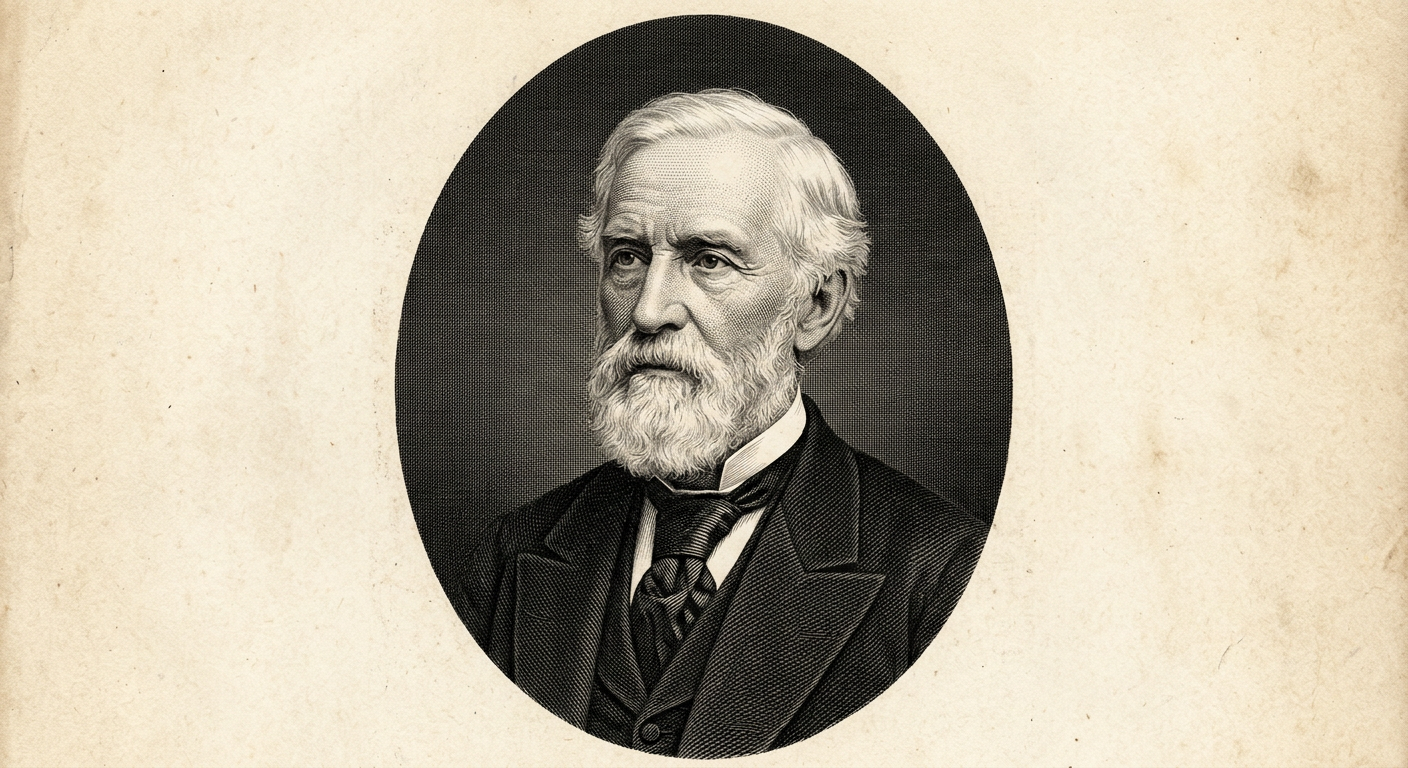
Henry Barnard was born in Hartford, Connecticut, on the twenty-fourth of January, in the year 1811, the son of Chauncey and Elizabeth (Andrews) Barnard. He was educated at Monson Academy and at Yale, admitted to the bar in 1835, and might have followed the placid career of a country jurist. He chose instead a labour more arduous and less remunerative: the construction, in the young American republic, of a universal system of public instruction.
Over sixty-five years of public life he served as Connecticut’s first Secretary of the Board of Commissioners of Common Schools, as State Commissioner of Public Schools in Rhode Island, as Principal of the Connecticut State Normal School, as Chancellor of the University of Wisconsin, as President of St. John’s College in Annapolis, and, in 1867, as the first Commissioner of the United States Department of Education. Between these offices he wrote, compiled, and edited without cease, at his own expense, the thirty-one volumes of the American Journal of Education—the most comprehensive record of educational thought in the English language then in existence.
He died in the same Hartford house in which he was born, on the fifth of July, 1900, having outlived by many years the generation whose schools he had built.
What Horace Mann accomplished as an orator, Barnard accomplished as a scholar. Together they founded what may fairly be called the Barnardian school of American public education — a body of doctrine which shaped the common schools of a continent.
That the education of every child, without regard to the accidents of birth or fortune, is the first duty of a self-governing people. A republic which does not instruct its citizens abandons them to be governed by others.
“The common school is common, not as a school for the common people, but as a school in which the children of the community, of all classes, conditions, and callings, are brought together to receive instruction in common.”
That no schoolhouse, however well appointed, and no curriculum, however well designed, can rise above the quality of those who stand before its classes. The professional preparation of teachers was, for Barnard, the indispensable precondition of every other reform.
“As is the teacher, so is the school. Every measure for the improvement of common schools must begin, and, in a great degree, end, with the improvement of those who are to teach them.”
That the school is not a private benefaction but a public trust, held in common by the community and financed by the community entire. In this Barnard broke decisively with the older tradition of the pauper school and the tuition academy.
“A free school system, worthy of the name, is a system of schools for all — equally free, equally good, and equally open.”
That a nation’s schools must be nourished by a living scholarship — by the study of educational history, of comparative pedagogy, of the great writers upon the subject in every European tongue. The American Journal of Education was the instrument Barnard built to this end.
“No system of instruction can long flourish which is not fed from the perennial springs of scholarship and reflection.”
From the year 1855 until 1881, at intervals dictated by his health, his private resources, and the exigencies of the several public offices he held during that period, Henry Barnard edited, financed, and in large part himself composed the American Journal of Education. Its thirty-one octavo volumes — more than twenty-two thousand printed pages in the aggregate — constitute the largest single work of educational scholarship produced in the nineteenth century.
Within its pages one finds treatises upon the schools of Prussia and of France; biographies of Pestalozzi, Fellenberg, and Fröbel; documentary histories of the American colleges; specimen curricula of the German gymnasium; papers upon the education of women, upon the deaf, upon the blind, upon the industrial and mechanic arts, upon physical training, upon school hygiene, and upon the architecture of schoolhouses. It was, in Barnard’s own phrase, a cyclopædia of education, arranged not by alphabet but by inquiry.
The complete run survives in the collections of the principal research libraries of the United States and of Europe. It remains today, as it was in its own time, the indispensable point of departure for the historical study of American education.
Henry Barnard was not, in his own lifetime, the more celebrated of the two great architects of the common school. Horace Mann had the eloquence; Barnard had the archive. But it was Barnard’s patient scholarship — his monographs, his statistical reports, his translations of the European authorities — that furnished the intellectual foundation upon which two full generations of American educators built.
His name endures across the American educational landscape — in institutions of learning, in scholarship, and in the enduring principle that public education is the foundation of a free republic. The federal office he first held has grown, in the century and a half since, into a department of state. The state boards he helped to establish govern, at this day, the schooling of every child within the union.
He is buried in the Old North Cemetery at Hartford, beneath a stone bearing no title and no epitaph beyond his name and dates. The monument he intended for himself was of another kind.